WHY MAKE IT
A little comfort, a lot of flavor.
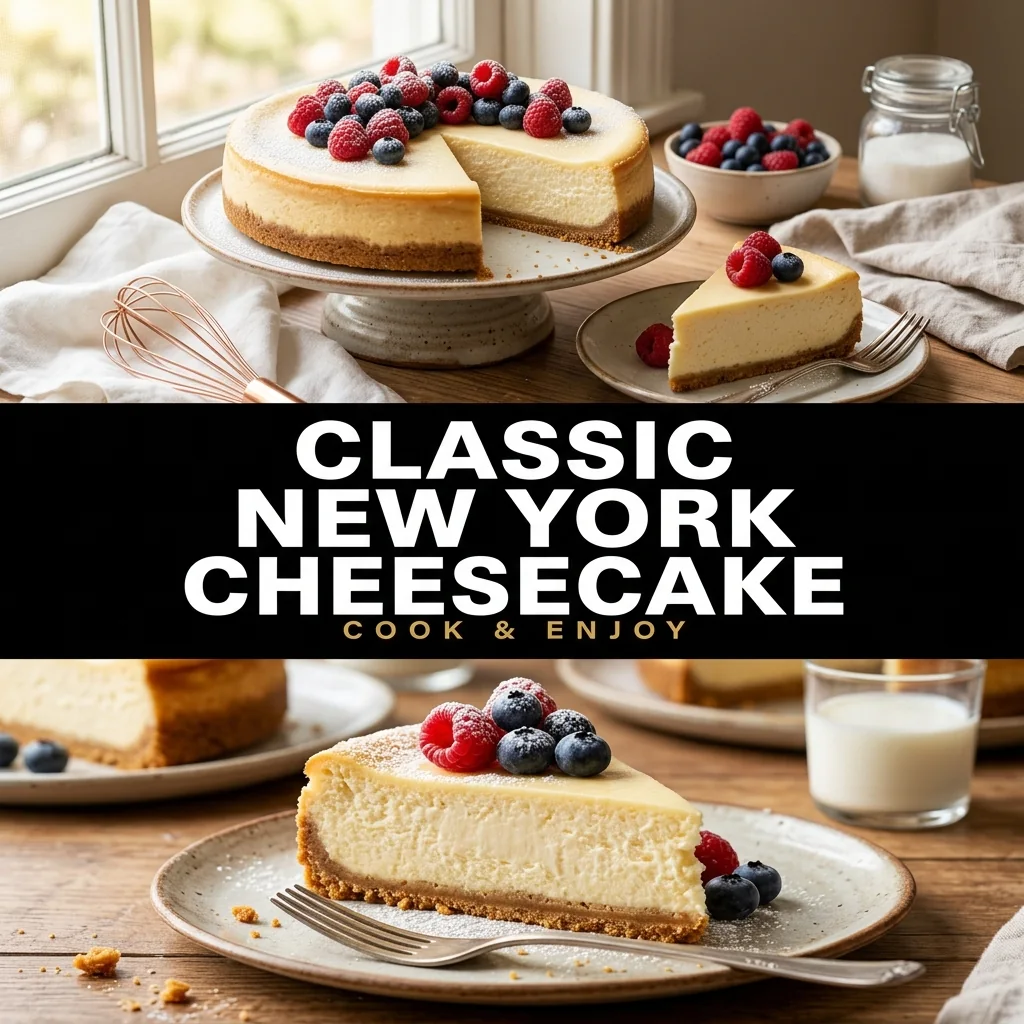
The authentic New York cheesecake stands apart from lighter continental iterations through its unapologetic density, silky richness, and assertive tang. Developed in urban American kitchens throughout the early twentieth century, this preparation relies on full-fat block cream cheese, cultured sour cream, and a modest touch of citrus zest to cut through the immense dairy richness. Rather than relying on gelatin or flour-heavy batters, structure is achieved through a deliberate egg-to-dairy ratio baked gently in a protective water bath. Taking time to cool the custard slowly within the receding heat of the oven ensures a flat, unblemished surface devoid of fractures, delivering the iconic bakery-case profile directly to your home table.
Emulsification and Aeration Control
The defining characteristic of an authentic New York cheesecake is its dense, satiny mouthfeel. Achieving this requires strict control over aeration. Beating eggs at high speed incorporates microscopic air bubbles that expand rapidly during baking and subsequently collapse, producing deep fissures across the crown. Mix exclusively on low speed with a paddle attachment rather than a whisk. Adding cornstarch stabilizes the protein network, preventing the egg proteins from over-coagulating into curd-like grains. Scraping down the bowl repeatedly ensures dense unmixed pockets do not mar the final silky texture.
The Low-and-Slow Water Bath
Custards behave predictably under controlled thermodynamic conditions. Baking a tall cheesecake directly on dry oven heat exposes the delicate outer perimeter to excessive temperatures long before the core reaches doneness, causing overbaking, curdling, and shrinking. A bain-marie acts as an insulating heat buffer, maintaining a maximum surrounding temperature of 212°F (100°C). Water vapor also elevates humidity within the oven chamber, preventing the delicate top surface from drying out prematurely. Ensure heavy-duty aluminum foil seals the pan base completely, as water seepage will ruin an otherwise crisp crust.
Clean Slicing and Temperature
Never attempt to slice a cheesecake while it retains residual heat. At warm temperatures, the dairy fats and egg proteins remain loosely structured, yielding ragged, torn slices. A full overnight chill solidifies the butter in the crust and allows the dairy matrix to set firmly. For professional presentation, dip a long, non-serrated chef knife into a tall vessel of hot water, wipe the blade completely dry on a clean lint-free towel, and execute a single downward stroke. Wipe and reheat the blade between every cut.
Before you start
Room temperature ingredients are mandatory for achieving a silky, lump-free emulsion without whipping unwanted air into the batter. Soften only the ingredients needed for the recipe, keeping total time out of refrigeration under 2 hours, or under 1 hour above 90°F (32°C). If small lumps persist in your base, press the batter through a fine-mesh sieve before pouring it over the baked crust.
THE RECIPE
Classic New York Cheesecake
12 servings · 30 minutes preparation · 85 minutes cooking · 480 minutes cooling, chilling or resting
Ingredients
Step-by-step instructions
- Position an oven rack in the middle position and preheat the oven to 350°F (175°C). Lightly grease a 9-inch (23 cm) springform pan with butter and line the bottom with parchment paper. Wrap the exterior base and outer walls tightly in two heavy-duty layers of aluminum foil to seal against water infiltration.
- Combine the graham cracker crumbs, melted butter, 30 grams of sugar, and fine sea salt in a medium bowl until the mixture resembles damp sand. Press the crumbs evenly across the bottom and 1 inch (2.5 cm) up the sides of the prepared pan. Bake for 10 minutes, then cool completely on a wire rack.
- Reduce the oven temperature to 325°F (165°C). In the bowl of a stand mixer fitted with the paddle attachment, beat the softened cream cheese, remaining 250 grams of granulated sugar, and cornstarch on medium-low speed for 3 minutes until completely smooth, scraping the bowl sides and paddle thoroughly to eliminate lumps.
- Add the full-fat sour cream, vanilla extract, and lemon zest to the cream cheese mixture. Beat on low speed for 1 minute until incorporated. Operating the mixer on low speed prevents excess air entrapment, which causes the cheesecake to puff unevenly and crack during baking and cooling.
- Incorporate the whole eggs and egg yolk one at a time on low speed, mixing just until each yolk disappears before adding the next. Pour the satiny batter over the cooled graham crust, gently tapping the pan against the counter twice to release any trapped subsurface air pockets.
- Set the wrapped springform pan inside a large, high-sided roasting pan. Pour boiling water into the roasting pan until it reaches halfway up the sides of the springform. Carefully slide the assembly into the oven and bake at 325°F (165°C) for 65 to 75 minutes.
- Check doneness by gently nudging the pan: the outer 2 inches (5 cm) should be set while a 3-inch (8 cm) circle in the center retains a slight, uniform jiggle, reading 150°F (66°C) on an instant-read thermometer. Turn off the oven, prop the door ajar with a wooden spoon, and cool inside for 60 minutes.
- Transfer the springform pan to a wire rack to reach room temperature for 1 hour. Remove the foil wrap, loosely cover the pan with plastic wrap, and refrigerate for at least 6 hours, preferably overnight, before releasing the springform ring and slicing with a warmed knife.
Kitchen notes
Room temperature ingredients are mandatory for achieving a silky, lump-free emulsion without whipping unwanted air into the batter. Soften only the ingredients needed for the recipe, keeping total time out of refrigeration under 2 hours, or under 1 hour above 90°F (32°C). If small lumps persist in your base, press the batter through a fine-mesh sieve before pouring it over the baked crust.
Storage & make-ahead
Store chilled in an airtight container or under a cake dome for up to 5 days. For freezing, slice the chilled cake, wrap individual portions tightly in parchment and double layers of aluminum foil, and store up to 2 months. Thaw frozen slices overnight in the refrigerator; avoid microwave thawing.
An original recipe guide inspired by themes in our Pinterest research. Recipe has not been independently kitchen-tested. AI-generated image is illustrative; your finished dish may look different.
Frequently asked questions
Why did the top of my cheesecake crack?
Cracking stems from excessive aeration during mixing, overbaking beyond 155°F (68°C), or cooling too rapidly. Rapid thermal shock contracts the surface while the center remains expanded, tearing the surface. Always cool the cake gradually inside the turned-off oven with the door propped slightly open.
Can I omit the water bath for this recipe?
Omission risks sunken centers, scorched edges, and broad surface fissures. If you cannot submerge your springform pan, place a roasting pan filled with boiling water on the lowest rack directly beneath the cheesecake to provide humidity, though the water bath yields superior texture.
How do I know the center is properly cooked?
A properly baked cheesecake will not look entirely firm. The outer border should be set and matte, while the central 3 inches should wobble like set gelatin when the pan is tapped. An instant-read probe placed dead center should register 150°F to 155°F (66°C to 68°C).