WHY MAKE IT
A little comfort, a lot of flavor.
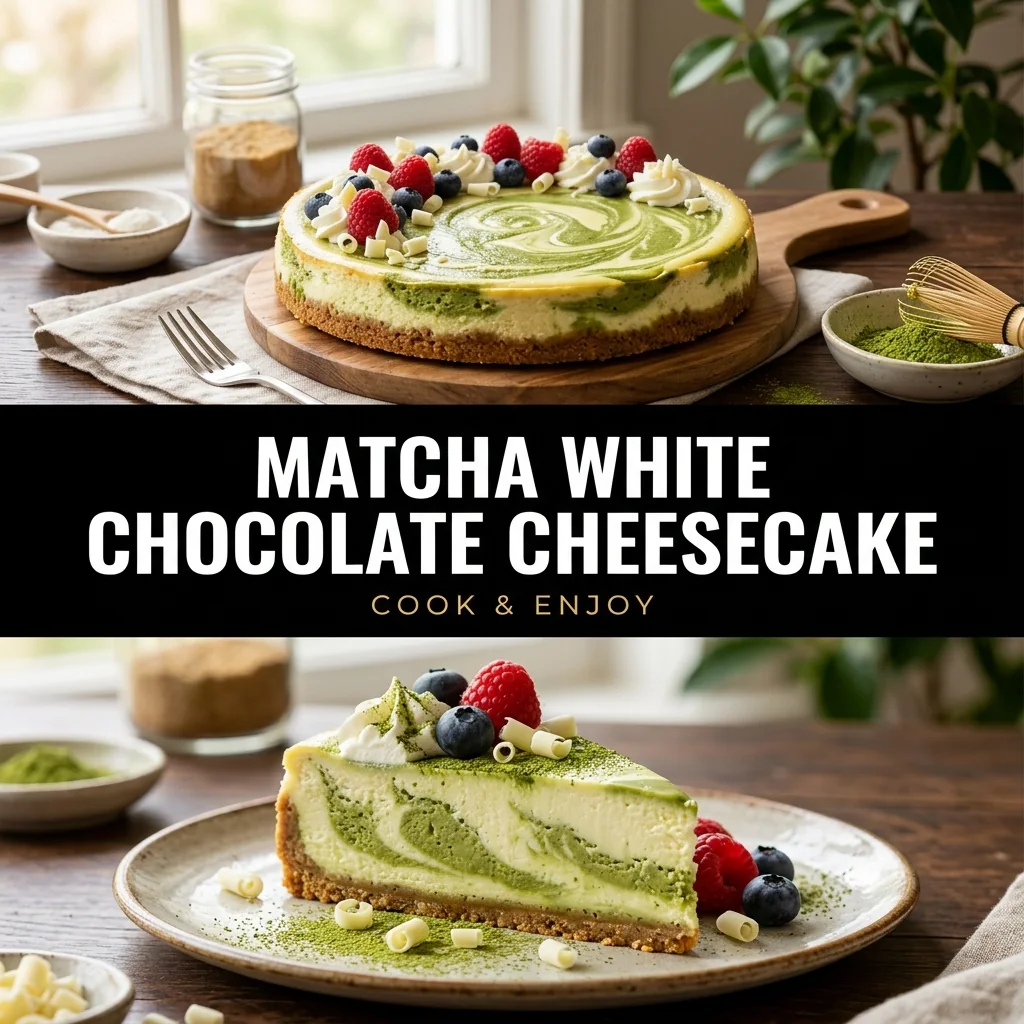
Matcha White Chocolate Cheesecake brings together the earthy vegetal depth of Japanese green tea and the mellow, milky sweetness of cocoa butter. While matcha can sometimes present an astringent edge when paired with sharp ingredients, the richness of high-grade white chocolate softens its intensity into a harmonious dessert. Baking this custard in a water bath moderates heat transfer, yielding a uniform texture without a puffed or cracked surface. The buttery biscuit base grounds the filling with a gentle crunch, contrasting the silky, jade-colored crumb. Designed for home bakers seeking elegance without unnecessary complexity, this cheesecake delivers a stunning visual presence and balanced flavor profile suitable for dinner parties or holiday dessert spreads.
Selecting Quality Matcha and White Chocolate
The success of this cheesecake depends heavily on ingredient selection. Use genuine white chocolate made with pure cocoa butter rather than confectionery coating bars formulated with palm oil, which fail to melt cleanly and produce a greasy film. For the tea, seek vibrant green culinary-grade or latte-grade matcha. Lower-grade powders often appear dull olive or yellowish-brown and deliver a harsh, bitter finish after baking. Sifting the fine tea powder removes dense clusters that naturally form during packaging, ensuring uniform distribution throughout the custard.
Water Bath Mechanics and Texture Control
A traditional bain-marie provides critical thermal insulation for egg-rich cheesecake batter. Direct dry oven heat tends to cook the perimeter of a cheesecake rapidly while the center remains raw, causing uneven shrinkage and severe surface fissures. Hot water moderates heat around the lower pan walls, helping the filling bake more gently. Ensure multiple layers of heavy-duty aluminum foil wrap the base and exterior walls to prevent water intrusion, or set the springform pan inside a slightly larger silicone cake pan.
Troubleshooting Cracks and Discoloration
Overbaking and rapid cooling represent the primary causes of cracked cheesecake surfaces. The custard is done baking when the outer three inches feel set and stable while the center two to three inches retain a gentle, jelly-like wobble. A long cooling period—resting first in the turned-off oven with the door cracked, followed by ambient counter cooling—allows internal steam to dissipate evenly. To preserve the brilliant green hue of the matcha, avoid baking at high temperatures, which brown the delicate tea pigments on top.
Before you start
Sift your matcha powder thoroughly before blending it into the cream cheese batter. Matcha particles clump instantly when exposed to moisture or fats, and clumps will not dissolve once beaten into cold dairy. Using culinary-grade or ceremonial-grade matcha guarantees a vibrant green color and a balanced grassy aroma without unwanted bitterness. For clean, sharp cuts, dip a thin chef knife in very hot water, wipe the blade completely dry with a clean kitchen towel, and slice, repeating between every cut.
THE RECIPE
Matcha White Chocolate Cheesecake
12 servings · 35 minutes preparation · 75 minutes cooking · 480 minutes cooling, chilling or resting
Ingredients
Step-by-step instructions
- Position an oven rack in the center and preheat your oven to 325°F (163°C). Grease a standard 9-inch springform pan with nonstick spray and line the bottom with a circle of parchment paper. Wrap the pan exterior tightly in two layers of heavy-duty aluminum foil to prepare for a water bath.
- Combine the finely crushed biscuits, melted unsalted butter, and 15 grams granulated sugar in a medium bowl until thoroughly moistened. Press the crumb mixture firmly and evenly across the bottom of the prepared springform pan. Bake at 325°F (163°C) for 10 minutes until set, then transfer to a wire rack to cool.
- Place the finely chopped white chocolate and 60 milliliters heavy cream in a heatproof bowl set over a small saucepan of simmering water. Stir gently with a silicone spatula until the mixture is fully melted, smooth, and glossy. Remove from heat and allow it to cool slightly to lukewarm room temperature.
- In a large mixing bowl, beat the softened cream cheese and 150 grams granulated sugar on medium-low speed for 2 minutes until completely smooth. Sift in the matcha powder, then add the kosher salt, vanilla extract, and room-temperature sour cream, beating on low speed until the color is uniformly vibrant green.
- Pour the lukewarm melted white chocolate mixture into the cream cheese batter, mixing on low speed until homogeneous. Add the room-temperature eggs one at a time, beating on low speed just until each yolk and white are incorporated, taking care not to whip excess air into the dense custard mixture.
- Pour the matcha batter over the cooled crust. Place the foil-wrapped springform pan into a large roasting pan and carefully pour boiling water into the outer pan until it reaches halfway up the sides. Bake at 325°F (163°C) for 55 to 60 minutes until the edges are set and center registers 160°F (71°C). Continue baking as needed to reach that temperature.
- Turn off the oven, prop the oven door open slightly with a wooden spoon handle, and let the cheesecake rest undisturbed inside for 60 minutes. Transfer the pan to a wire rack on the counter for 60 minutes, then refrigerate uncovered for at least 360 minutes (6 hours) until fully chilled before slicing.
Kitchen notes
Sift your matcha powder thoroughly before blending it into the cream cheese batter. Matcha particles clump instantly when exposed to moisture or fats, and clumps will not dissolve once beaten into cold dairy. Using culinary-grade or ceremonial-grade matcha guarantees a vibrant green color and a balanced grassy aroma without unwanted bitterness. For clean, sharp cuts, dip a thin chef knife in very hot water, wipe the blade completely dry with a clean kitchen towel, and slice, repeating between every cut.
Storage & make-ahead
Cover the completely cooled cheesecake securely in plastic wrap or store slices in an airtight container within 2 hours of removal from chilling. Store in the refrigerator at or below 40°F (4°C) for up to 4 days. Whole or sliced cheesecakes may be frozen, tightly double-wrapped in plastic wrap and aluminum foil, for up to 2 months. Thaw overnight in the refrigerator before serving. Cheesecakes are served chilled; do not leave dairy-based custard at room temperature beyond 2 hours.
An original recipe guide inspired by themes in our Pinterest research. Recipe has not been independently kitchen-tested. AI-generated image is illustrative; your finished dish may look different.
Frequently asked questions
Can I omit the water bath when baking this cheesecake?
Baking without a water bath increases the risk of edge overbrowning and surface cracking. If you cannot submerge the pan, place a roasting pan filled with boiling water on the bottom rack beneath the cheesecake to introduce moisture into the oven chamber throughout baking.
Why did my white chocolate seize when melting?
White chocolate is sensitive to high heat and stray moisture. Ensure the mixing bowl and utensils are completely dry, and keep the simmering water below low enough that it never touches the bowl base. Melting with warm heavy cream prevents overheating and smooths the emulsion.
Can I prepare this cheesecake several days in advance?
Yes, this cheesecake improves after chilling overnight because the matcha flavor deepens and the structure firms completely. You can bake it up to two days ahead, keeping it covered in its pan in the refrigerator at or below 40°F (4°C) until serving.